Intel Arc G3 and XeSS 3 Deliver Next-Gen Handheld Performance, but Pricing Threatens Market Adoption
The handheld PC gaming landscape is undergoing a significant technical transformation. With the rollout of Intel’s XeSS 3 technology and its Multi-Frame Generation (MFG) capabilities, hardware manufacturers are introducing a new generation of portable gaming devices powered by the Intel Arc G3 system-on-chip (SoC) architecture. Devices such as the MSI Claw 8 EX AI+, the Acer Predator Atlas 8, and the OneXPlayer 3 represent the first wave of hardware designed to deliver uncompromised 1080p gaming in a portable form factor.
However, while the architectural advancements allow these compact devices to achieve framerates previously reserved for full-sized gaming laptops, the practical reality of bringing this technology to market comes with substantial financial hurdles. Driven in part by widespread component supply pressures, the steep retail prices for these flagship handhelds raise critical questions about who this high-end segment is actually for.
The Architecture of Arc G3 and XeSS 3
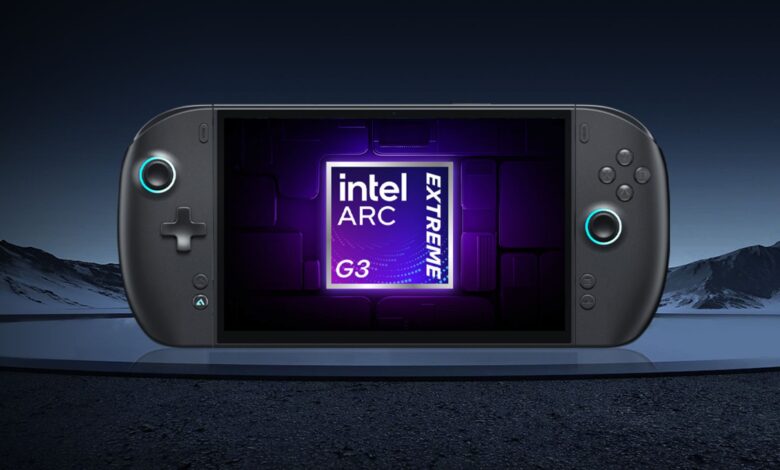
Intel’s Arc G3 lineup, built around the new Xe3 core architecture, represents Team Blue’s third generation of purpose-built SoCs tailored for mobile and handheld devices. The platform is structured around four primary development pillars: performance, integration, efficiency, and software optimization. Engineered to operate across low power envelopes, the hardware supports DirectX 12 Ultimate, hardware-accelerated ray tracing, AI-driven upscaling, and frame generation.
At the center of this performance push is XeSS 3. Similar to competing image-reconstruction suites like Nvidia DLSS and AMD FSR, XeSS 3 combines Super Resolution AI upscaling with Multi-Frame Generation and low-latency rendering pipeline adjustments. By inserting algorithmically generated frames between traditionally rasterized ones, the technology enables handheld displays to render games at a native 1080p resolution while maintaining fluid playability.
According to Intel’s internal performance metrics, partner handhelds utilizing the flagship Arc G3 Extreme chip can achieve up to 11 hours of gameplay under optimized battery settings while offering an average performance lead of up to 42% over competing mobile processors.
Evaluating Performance Across Power Profiles
The performance capabilities of the Arc G3 Extreme vary depending on power delivery, which scales across three distinct operational modes: 35W maximum performance (requiring external power delivery via USB-C PD), 17W standard battery mode, and 12W ultra-efficiency mode.
At the maximum 35W threshold, generation-over-generation comparisons against the previous-generation Intel Core Ultra 7 258V (operating at 30W) show performance gains ranging between 18% and 47% in 1080p rendering at High graphics settings. Intel claims an overall average performance increase of 44% compared to its prior hardware generation.
This hardware transition is particularly evident in demanding titles where older integrated graphics struggled to maintain baseline fluidity:
- Crimson Desert: Increased from under 30 FPS on the Core Ultra 7 258V to an average of 34 FPS on the G3 Extreme.
- Assassin’s Creed Shadows: Improved from below 30 FPS on prior silicon to a stable 35 FPS average.
- 60+ FPS Target Titles: Highly demanding games such as Battlefield 6, Pragmata, Baldur’s Gate 3, and Dying Light: The Beast cross the 60 FPS threshold at 1080p when paired with XeSS 3 upscaling.
When evaluated against direct handheld competitors—specifically the Asus ROG Xbox Ally X running AMD’s Z2 Extreme chip at 35W—the Arc G3 Extreme maintains an average 42% performance lead at 1080p High settings with upscaling enabled. In select titles, such as Death Stranding 2: On the Beach, the G3 Extreme recorded 56 FPS compared to 37 FPS on the Z2 Extreme. In Arc Raiders, Intel’s chip reached 100 FPS against AMD’s 67 FPS.
Battery Performance and Low-Power Efficiency
Handheld usability relies heavily on efficiency when disconnected from wall power. Operating on battery at a 17W profile, the G3 Extreme remains approximately 24% faster than the Ultra 7 258V at 1080p High settings. In this mode, demanding titles remain above 30 FPS, while games like Resident Evil Requiem and Diablo 4 reach averages of 60 FPS or higher.
At the restricted 12W power target—a profile historically difficult for handheld PCs due to severe thermal and power throttling—the G3 Extreme combined with low visual presets maintains 30 FPS in titles like Battlefield 6, Clair Obscur Expedition 33, and Dying Light: The Beast. Older or less intensive titles, including Grand Theft Auto V, F1 25, and Shadow of the Tomb Raider, sustain framerates exceeding 60 FPS even at this low wattage.
Hardware Availability and Premium Pricing Breakdown
Despite the technical achievements of the Arc G3 platform, the commercial reality presents a major friction point for consumers. An ongoing global RAM crisis and broader component supply constraints have escalated production costs across the semiconductor industry. As a result, incoming Arc G3 handhelds are priced significantly higher than existing alternatives like the Steam Deck OLED, Lenovo Legion Go 2, or AMD Z2-powered handhelds.
Pricing structures announced for the Acer Predator Atlas 8 and the OneXPlayer 3 demonstrate the premium positioning of these upcoming devices:
| Device Model | Processor Variant | Memory / Storage | Retail Pricing |
|---|---|---|---|
| Acer Predator Atlas 8 | Standard Arc G3 | 16GB RAM / 512GB SSD | £999.99 (Approx. $1,363 / AU$1,915) |
| Acer Predator Atlas 8 | Arc G3 Extreme | 24GB RAM / 1TB SSD | £1,299.99 (Approx. $1,772 / AU$2,490) |
| Acer Predator Atlas 8 | Arc G3 Extreme | 32GB RAM / 1TB SSD | £1,499.00 (Approx. $2,043 / AU$2,871) |
| OneXPlayer 3 (Early Bird) | Arc G3 Extreme | 24GB RAM / 512GB SSD | $1,499.00 (Approx. £1,100 / AU$2,100) |
| OneXPlayer 3 (Early Bird) | Arc G3 Extreme | 24GB RAM / 1TB SSD | $1,599.00 (Approx. £1,170 / AU$2,245) |
| OneXPlayer 3 (Early Bird) | Arc G3 Extreme | 32GB RAM / 1TB SSD | $1,799.00 (Approx. £1,319 / AU$2,527) |
| OneXPlayer 3 (Post-Launch) | Arc G3 Extreme | 24GB RAM / 512GB SSD | $1,699.00 (Approx. £1,245) |
| OneXPlayer 3 (Post-Launch) | Arc G3 Extreme | 24GB RAM / 1TB SSD | $1,899.00 (Approx. £1,392 / AU$2,667) |
| OneXPlayer 3 (Post-Launch) | Arc G3 Extreme | 32GB RAM / 1TB SSD | $2,099.00 (Approx. £1,539 / AU$2,949) |
Market Value Analysis: High Costs vs. Practical Alternatives
The entry price of roughly $1,350 to over $2,000 creates a challenging value proposition for prospective buyers. When Valve launched the original Steam Deck LCD priced between $399 and $649, it established a baseline for accessibility by leveraging modest hardware (RDNA 2 graphics driving a 720p screen) to deliver acceptable performance at an affordable cost.
The current tier of Arc G3 Extreme handhelds shifts the category back toward boutique, luxury pricing. For gamers weighing price-to-performance ratios, several comparative factors emerge:
- Gaming Laptops: Modern laptops equipped with dedicated RTX 5070 graphics—such as the Acer Nitro V 16 AI, MSI Katana 15 HX, or Gigabyte Gaming A16—are available at comparable or lower price points, offering significantly higher raw graphics performance and larger displays, albeit with reduced portability.
- Dedicated Consoles: Home consoles like the PlayStation 5, Xbox Series X, or Nintendo Switch 2 cost a fraction of these high-end handhelds while targeting dedicated television ecosystems without requiring manual upscaling or driver tweaking.
- Existing PC Gamers: Players who already own a primary desktop or laptop may find it difficult to justify spending upwards of $1,500 on a secondary device intended purely for gaming on the go.
The Path Forward for Handheld PC Gaming
Intel’s Arc G3 silicon and XeSS 3 suite prove that high-framerate 1080p gaming is technically feasible within a compact handheld chassis. The architectural improvements in power efficiency at 17W and 12W show meaningful progress toward solving the battery life challenges that have historically plagued mobile x86 devices.
However, technical capability alone does not guarantee commercial success. If hardware manufacturers cannot navigate component cost increases to bring secondary device pricing back to accessible levels, the handheld PC market risks fracturing. While enthusiast buyers may embrace these high-end machines, the broader mainstream audience could remain anchored to more cost-effective options until manufacturing costs stabilize.