Anthropic Introduces Model Hardware Standard to Bridge AI Agents and Physical Machinery
Artificial intelligence agents have rapidly mastered digital workflows, writing code, analyzing text, and querying databases with high proficiency. However, translating those capability gains into the physical world has historically run into a major barrier: the fragmented, highly specialized software interfaces required to control real-world equipment. Connecting an AI model to laboratory instruments or industrial machinery has traditionally required months of custom engineering, delicate driver configurations, and tailored glue code.
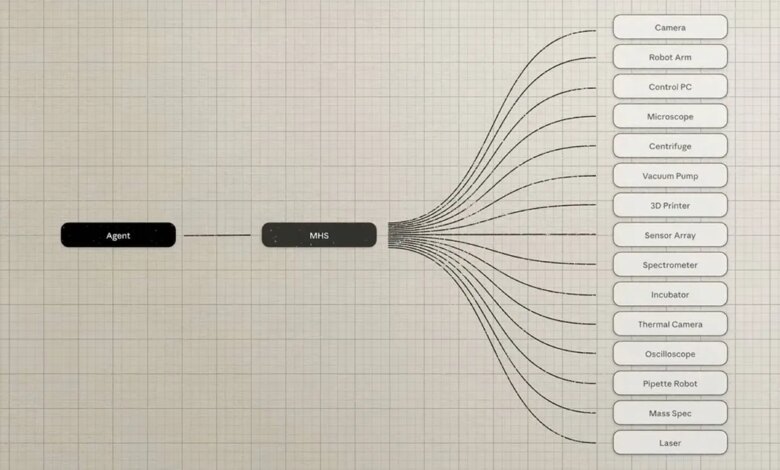
To eliminate this bottleneck, Anthropic has unveiled a research preview of its Model Hardware Standard (MHS). Designed as a unified specification for hardware control, MHS provides a universal bridge that enables foundation models to operate laboratory instruments, robotic components, and manufacturing machinery directly. By replacing vendor-specific code with a standardized communication layer, the framework aims to reduce hardware integration timelines from several months to a matter of hours or minutes.
A Universal Protocol for Physical Equipment
The operational philosophy behind MHS draws directly from Anthropic’s earlier work on the Model Context Protocol (MCP), which standardized how AI models connect to software applications and data stores. Where MCP established a common vocabulary for digital APIs, MHS performs an equivalent function for physical devices. It acts as a neutral translation layer that converts abstract model intents into precise, machine-executable actions.
Rather than requiring developers to write bespoke drivers for every unique instrument, MHS standardizes device communication through unified command interfaces and machine-readable reference files. These reference files automatically define a device’s operational capabilities, supported commands, acceptable configuration parameters, and absolute safety limits. Because the framework is fully model-agnostic, any AI system capable of generating structured tool calls can interact with MHS-compliant hardware provided it features a programmable interface.
This approach changes how hardware safety is enforced. Instead of trusting an generative model to maintain operational boundaries on its own, safety rules and mechanical tolerances are defined directly within the hardware reference files. This ensures that commands exceeding safe operational parameters are identified and rejected before any physical component receives power.
Demonstrated Performance in Advanced Engineering and Science
Early deployment trials conducted across research universities, quantum computing facilities, and pharmaceutical laboratories suggest that standardized hardware abstraction can dramatically accelerate technical workflows.
At quantum computing company QuEra Computing, engineers evaluated MHS in an intricate laser-relocking task. Previously, a four-person engineering team had devoted months to developing a custom automation script for laser recovery. That legacy script required 150 seconds per recovery attempt and achieved a successful relock in only 58% of instances. Utilizing MHS and four Claude instances in an overnight optimization loop, the AI agent completely restructured the recovery procedure. During initial testing, the AI-driven approach reduced recovery time to six seconds while boosting success rates to 96%. In a subsequent 700-trial blind evaluation, the system maintained a 99.3% success rate. In a separate 16-hour unattended calibration task, the agent tuned 12 interdependent servo parameters simultaneously, reducing residual error from 15.7 mV to 1.55 mV.
At Carnegie Mellon University (CMU), researchers used MHS to orchestrate a complex automated laboratory workcell spanning four discrete instruments—a liquid handler, a microplate reader, a robotic transfer arm, and visual inspection cameras—distributed across three connected computers. Setting up such multi-device research rigs traditionally requires weeks of systems integration. With MHS, the CMU team completed full system integration in eight hours. Controlled by a Claude Opus 4.8 agent, the unified setup executed serial dilution experiments at three times the speed of human manual operation.
Similarly, biotechnology company Genentech deployed MHS across an automated protein assay pipeline. In this environment, the AI agent dynamically adjusted and optimized fluid transfer parameters in real time to accommodate solutions with fluctuating viscosity levels.
| Organization | Primary Application | Key Benchmark Results | Integration and Operational Impact |
|---|---|---|---|
| QuEra Computing | Laser-relocking & servo parameter tuning | Recovery time cut from 150s to 6s; success rate rose from 58% to 99.3% | Tuned 12 interdependent parameters unattended, dropping error from 15.7 mV to 1.55 mV |
| Carnegie Mellon University | Multi-instrument lab workcell orchestration | Serial dilution testing executed 3x faster than manual baseline | Full 4-device workcell integrated in 8 hours compared to typical multi-week setup |
| Genentech | Automated protein assay workflows | Dynamic transfer rate optimization for variable sample viscosities | Eliminated manual re-calibration across variable sample conditions |
Safety Controls and the Realities of Physical Interaction
Integrating generative models with physical hardware introduces failure modes that do not exist in pure software environments. Physical systems are subject to mechanical wear, fluid surface tension, optical obstruction, and strict thermal constraints. Consequently, safety verification must operate independently of the AI model’s cognitive state.
During safety testing at Carnegie Mellon University, researchers intentionally introduced six distinct fault conditions into the workcell instructions. In every instance, the MHS framework intercepted the invalid instructions and blocked execution prior to physical movement, validating the efficacy of hardcoded reference limits.
However, the pilot programs also highlighted fundamental challenges in how language-based AI models conceptualize physical space and mechanical reality. During trials at Genentech, an automated fluid handling channel encountered an internal bubble, halting fluid transfer. Because the AI model lacked direct sensory perception of the physical tubing, it repeatedly re-issued the same software command under the assumption that the failure stemmed from a digital execution error. Human intervention was necessary to clarify that the system was dealing with a mechanical obstruction rather than a software bug.
This incident illustrates a critical limitation of current physical AI agents: because models process physical environments almost exclusively through structured text logs, sensor outputs, and 2D camera feeds, true spatial reasoning and real-world troubleshooting remain constrained. For the foreseeable future, expert human oversight remains essential for monitoring edge cases where digital signals fail to capture underlying physical state changes.
Ecosystem Partnerships and Future Outlook
Anthropic is currently offering access to MHS on a waitlist basis to selected academic institutions, industrial research facilities, and hardware manufacturers. To build a broad hardware ecosystem, the company is collaborating with major instrument and automation vendors, including laboratory automation provider Tecan, industrial robotics developer Universal Robots, and cloud infrastructure provider Amazon Web Services (AWS).
The standard is also finding early traction within the open-source hardware and developer communities. Open-source AI platform Hugging Face plans to integrate MHS support into its LeRobot robotics initiative, while driver compatibility testing is underway on low-cost computing hardware like the Raspberry Pi.
While Anthropic has expressed its intention to eventually release the Model Hardware Standard under an open-source license, specific details regarding publication dates, open schema standards, and long-term technical governance have not yet been formalized. If broadly adopted, MHS could provide the foundational protocol needed to transform scientific research and automated manufacturing, shifting industrial hardware from static script execution to dynamic, adaptive AI control.