Anker Nano 7-in-1 Charging Station Drops to $60: A Practical Solution for Desktop Cable Management
Modern desktop setups frequently suffer from accumulated cable clutter. Between powering external monitors, desktop computers, laptops, tablets, and handheld devices, workstations quickly become crowded with bulky power strips and dangling wall adapters. To address this persistent organizational challenge, hardware accessories have increasingly evolved from simple extension cords into multi-functional power hubs designed for the desktop surface. Anker’s 7-in-1 Nano Charging Station represents this shift, offering a centralized power node engineered to replace conventional floor strips while delivering high-speed USB charging. Currently discounted on Amazon to just under $60—reflecting a $20 reduction from its standard $80 list price—the accessory presents an opportune entry point for users looking to streamline their workspace organization.
Architectural Layout: Segregating AC and DC Power Needs
The core utility of a multi-device charging station lies in how effectively it manages different types of power connections. The Anker Nano features seven distinct output points, arranged deliberately across its compact housing to separate heavy AC power cords from lower-voltage USB charging cables.
On the rear panel of the unit, three standard AC outlets accommodate primary desktop equipment. By locating these high-voltage plugs on the back, bulky cords for computer monitors, desktop towers, or desk lamps remain directed toward the rear of the desk and out of sight. This design choice prevents thick AC cables from spilling across the primary work surface, maintaining a cleaner visual environment.
For auxiliary equipment, the side of the housing includes two additional fixed ports: one standard USB-A port and one USB-C port. Positioning these ports on the lateral edge provides convenient access for temporary connections, such as plugging in specialized charging pucks, wireless headphones, or legacy USB accessories, without disrupting the main cable arrangement.
Built-in Retractable Cables and Cable Control
A central feature of the Nano station is its inclusion of two built-in retractable USB-C cables integrated directly into the chassis. Rather than forcing users to supply, route, and manage separate charging cords—which often slip behind desks or tangle when idle—the station houses two internal spring-loaded spools.
Each retractable cable extends out to approximately 2.3 feet (roughly 28 inches). This length provides adequate reach for standard desktop arrangements, allowing users to connect a laptop elevated on a stand or plug in a smartphone resting adjacent to a keyboard. When charging is complete, a gentle pull releases the latch mechanism, drawing the cable back neatly inside the main housing.
The practical significance of this integrated mechanism is twofold. Operationally, it eliminates the need to maintain loose cables on the desk. Structurally, housing the cables inside the unit protects the wire jacket and connectors from bending or tangling. However, prospective users should account for the 2.3-foot restriction when planning their workspace. Hardware located farther away will require standard external cables connected via the auxiliary side ports or rear AC outlets.
Power Distribution Performance and Real-Time Telemetry
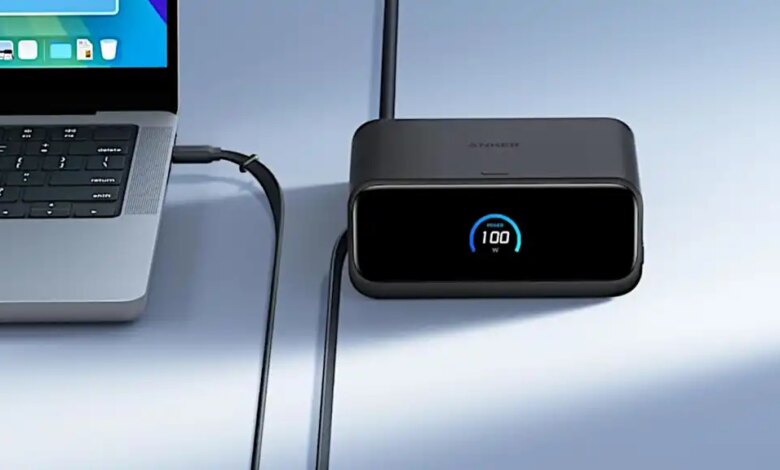
Power delivery performance is a critical consideration when consolidating multiple charging bricks into a single desktop hub. When utilized individually, either of the integrated retractable USB-C cables can output up to 100 watts of power. A 100W output ceiling is substantial, providing sufficient wattage to fast-charge power-hungry devices including modern ultrabooks, tablets, and high-capacity smartphones at maximum speeds.
However, operational dynamics adjust when multiple devices are plugged in simultaneously. When several ports and retractable cables are drawing power at the same time, the station’s internal controller splits the available wattage across the active connections. While a single connected laptop can utilize the full 100W capacity, adding a phone or tablet to the secondary ports will redistribute the overall power allocation, adjusting individual charging rates accordingly.
To provide transparency during multi-device charging, the Nano charging station includes a built-in LCD display on its front face. This screen delivers real-time readout telemetry regarding charging status and power output. Rather than leaving users to guess whether a laptop is receiving maximum wattage or slow-charging, the display offers immediate visual confirmation of current operational metrics.
Technical Specifications Overview
The table below summarizes the key hardware specifications, port availability, and functional capabilities of the Anker 7-in-1 Nano Charging Station based on manufacturer details.
| Feature / Attribute | Specification Detail | Practical Advantage |
|---|---|---|
| Total Output Ports | 7 Total (3 AC Outlets, 2 Retractable USB-C, 1 USB-C Port, 1 USB-A Port) | Consolidates desktop computer gear and mobile accessories into one device. |
| Maximum Single-Port Output | Up to 100W via USB-C | Enables fast charging for laptops and tablets without separate wall adapters. |
| Retractable Cable Reach | 2.3 Feet (~28 Inches) | Eliminates loose cord clutter by reeling cables into the chassis when idle. |
| Status Monitoring | Integrated Real-Time LCD Display | Provides immediate visual data on live power delivery and charging status. |
| Promotional Pricing | Under $60 ($20 off typical list price) | Reduces the cost of upgrading workspace power infrastructure. |
Evaluating Desktop Value and Practical Considerations
At its current $60 price point, the Anker Nano 7-in-1 Charging Station presents a practical value proposition for users seeking to clean up cluttered work areas. Purchasing standalone high-wattage USB-C wall chargers, extension power strips, and retractable cable accessories individually often incurs a higher cumulative cost while occupying significantly more plug space.
The primary benefit of this design lies in consolidation. By combining three standard AC pass-through outlets with high-capacity DC charging infrastructure, the unit functions as both a heavy-duty power tap and a high-speed device charger. Remote workers, students, and professionals operating within limited desk footprints stand to gain the most from replacing bulky floor strips with a single neat desktop hub.
Potential buyers should nevertheless evaluate their specific hardware placement before purchasing. Because the retractable USB-C cables measure 2.3 feet, desks requiring longer runs to reach mobile devices may still depend on traditional standalone cables plugged into the lateral ports. Additionally, users who frequently run multiple high-draw devices simultaneously should keep in mind that total available power is shared when all outputs are active. Within those operational parameters, the $20 discount makes the Anker Nano a compelling and cost-effective upgrade for desktop cable management.