Rethinking Hillside Drainage: Why Landscape Fabric Fails on Slopes and What to Use Instead
Managing a sloped yard presents distinct horticultural and structural challenges. When rain hits a hill, loose topsoil washes away easily, creating gullies and stripping away valuable organic nutrients. In an effort to find a quick, low-maintenance solution for soil erosion and weed control, many homeowners turn to synthetic landscape fabric. Commercially touted as a versatile tool for suppressing weeds, stabilizing ground cover, and managing water, landscape fabric appears to offer a simple barrier against landscape degradation.
However, professional landscapers increasingly caution against using landscape fabric on sloped terrain. Far from solving erosion and runoff problems, synthetic barriers often exacerbate downhill water flow and harm long-term soil health. Understanding why landscape fabric fails on inclines—and exploring superior alternatives like erosion control wattles, terracing, and strategic planting—allows property owners to build a resilient, well-drained landscape that works alongside natural hydrological processes.
The Hidden Mechanics of Landscape Fabric on Slopes
Landscape fabric is manufactured in both woven and non-woven varieties designed to separate soil layers and prevent weeds from taking root. However, when laid over a hillside, the physical characteristics of the material frequently counter effective water management.
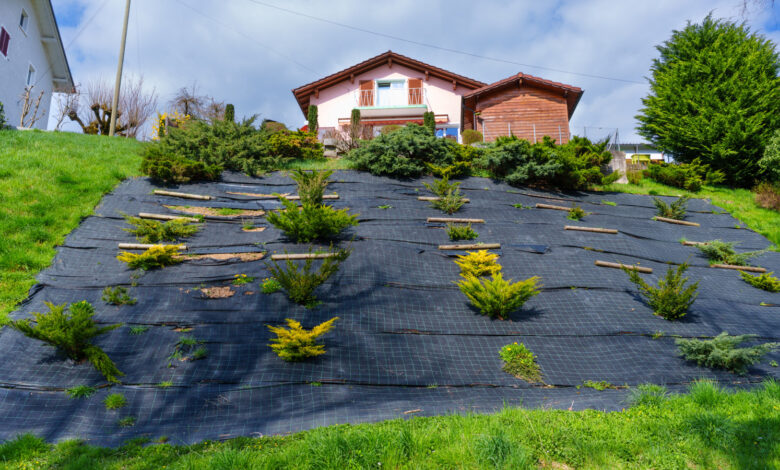
Tightly woven synthetic fabrics form a dense boundary over the soil surface. During heavy or sustained rain, water hits the fabric faster than it can pass through the material. Because gravity pulls surface water down the incline, the tight weave creates a smooth surface over which water glides. Instead of soaking deep into the ground where plant root systems can access it, heavy rain sheets off the synthetic layer, accelerating downhill runoff. This rapid movement of surface water can strip away decorative mulch, concentrate erosion at the foot of the hill, and leave the soil beneath dry.
Even non-woven landscape fabric, which is designed with higher permeability to allow better drainage, poses significant risks on slopes. If soil preparation is inadequate or fine sediment clogs the small openings in the fabric over time, non-woven sheeting behaves similarly to woven material, repelling water rather than absorbing it.
Beyond accelerating surface runoff, landscape fabric introduces biological drawbacks for established plants. Healthy soil requires a continuous exchange of atmospheric gases, including oxygen and carbon dioxide, between the subterranean environment and the surrounding air. Synthetic barriers severely restrict gas diffusion. Over time, restricted airflow suffocates beneficial soil micro-organisms and restricts root development for larger plants, shrubs, and trees. Instead of stabilizing the incline, landscape fabric can gradually weaken the very vegetative structures required to hold a slope together naturally.
Erosion Control Wattles: How Natural Barriers Manage Runoff
When immediate physical intervention is required to stop soil movement on a hill, gardening experts and landscape contractors frequently recommend erosion control wattles instead of synthetic sheeting.
Wattles are long, flexible, cylindrical rolls packed tightly with natural organic fibers such as coconut coir or straw. Unlike flat landscape fabric, which creates a slick surface for water to slide over, wattles form three-dimensional physical barriers across the face of a slope.
The core principle behind erosion control wattles is velocity reduction and natural filtration rather than complete water blockage. When surface runoff flows downhill and contacts a wattle log, its momentum is interrupted. While water continues to flow through the porous, fibrous matrix, its downward speed is reduced significantly. This deceleration provides the water with enough time to infiltrate the soil gradually behind and beneath the wattle, encouraging deep soil hydration without causing surface scouring.
Simultaneously, wattles act as efficient sediment traps. As runoff filters through the dense natural fibers, suspended topsoil, silt, and natural debris are captured on the uphill side of the roll. Over time, these trapped sediments settle into small, natural terraces along the incline, stabilizing the slope and filling minor depressions.
Best Practices for Installing and Utilizing Wattles
For erosion control wattles to function effectively, proper placement and installation techniques are essential. Simply laying a wattle roll across a hill is insufficient, as unanchored logs allow water to wash underneath the barrier.
Standard erosion wattles measure approximately 25 feet in length and 9 inches in diameter, though their flexible construction allows them to conform easily to uneven terrain. To prevent runoff from undercutting the cylinder, installers must entrench the wattle slightly into the ground, burying the base below the soil line.
Wattles must always be installed perpendicular to the direction of water flow. Depending on the steepness and length of the gradient, they can be placed along the natural contours of the slope at regular intervals, at the crest of the hill to intercept runoff early, or at the base of the slope to capture remaining sediment.
A major benefit of natural-fiber wattles is their eventual biodegradation. Over time, materials like straw and coir decompose naturally through biological activity, returning organic matter to the earth and improving overall soil health. Because wattles are inherently temporary interventions, they buy valuable time for property owners to establish permanent ground cover. Before the wattle fully breaks down, permanent turf or stabilizing plants should be introduced to take over long-term erosion control.
Long-Term Structural Solutions: Terracing and Strategic Planting
While erosion control wattles offer an effective medium-term defense against soil loss, permanent slope stability requires lasting structural or vegetative modifications.
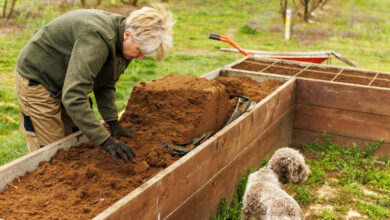
For steeper gradients or yards where functional garden space is desired, terracing serves as an ancient, highly effective landscaping method. Terracing involves digging into a hill to create a series of stepped, flat platforms supported by retaining walls or natural steps. Instead of a single continuous incline where water and soil rush toward the bottom during heavy rains, terracing converts the hill into level tiers suitable for growing fruits, vegetables, or ornamental flowers. Although terracing requires intensive initial digging and construction labor, it eliminates slope runoff and turns problematic terrain into usable garden beds.
Alternatively, strategic vegetative planting relies on living root systems to bind soil and regulate water flow. Above ground, plant foliage breaks the physical impact of falling rain; below ground, root networks form a tight grid that holds soil particles in place.
Selecting the right species is vital for hillside health. Deep-rooted ornamental grasses excel at locking surface soil in place while permitting excess moisture to filter into the ground naturally. Combining grasses with hardy trees and shrubs creates a multi-layered root system capable of anchoring deeper soil strata. When established alongside temporary wattles, targeted vegetation builds a self-sustaining ecosystem that eliminates the need for problematic synthetic fabrics entirely.
Comparing Slope Management Options
Understanding how different slope stabilization methods interact with water and soil biology helps property owners select the right strategy for their terrain.
| Stabilization Method | Primary Water Mechanics | Impact on Soil Health | Ideal Operational Use |
|---|---|---|---|
| Landscape Fabric | Accelerates downhill runoff by restricting infiltration | Limits gas diffusion and hinders subterranean micro-organisms | Flat garden beds requiring temporary weed barrier separation |
| Erosion Control Wattles | Slows water velocity while filtering and trapping sediment | Decomposes into beneficial organic matter over time | Temporary hillside stabilization while establishing living plants |
| Terracing | Eliminates incline runoff by creating flat, level tiers | Preserves topsoil structure and maximizes moisture retention | Permanent structural transformation of steep slopes for active gardening |
| Strategic Planting | Absorbs moisture directly while root networks bind soil | Enhances soil aeration, biology, and long-term ecosystem health | Permanent vegetative slope stabilization using trees, shrubs, and grasses |
Building a Sustainable Hillside Landscape
Managing a sloped yard effectively requires working alongside natural hydrology rather than attempting to seal the earth with non-porous barriers. While landscape fabric remains a common consumer product, its tendency to speed up surface runoff and block essential gas exchange makes it poorly suited for sloped terrain.
By replacing synthetic sheeting with flexible erosion control wattles, property owners can slow water flow, retain precious topsoil, and gradually enrich their land. When paired with long-term practices like terracing or planting resilient trees, shrubs, and ornamental grasses, natural erosion control methods turn challenging hillsides into stable, thriving landscape features.