Xteink X4 Pro Review: A Great $99 Mini Ereader, But It Won’t Replace Premium Rivals

The Xteink X4 Pro Ultra-Compact E-Reader: Innovation, Friction, and the Sideloading Reality
The concept of carrying a dedicated e-reader on the back of a smartphone has moved from a niche hardware concept into a functional product line with the release of the Xteink X4 Pro. Following the initial release of the original Xteink X4 in early 2026, the updated Pro model introduces core features that were conspicuously missing from its predecessor, most notably a touch-sensitive interface and an integrated front light. While these additions significantly improve the reading experience, the device remains defined by a sharp contrast between hardware convenience and software friction.
At its core, the Xteink X4 Pro addresses a specific habit: enabling quick reading sessions during brief moments of downtime throughout the day by ensuring an e-paper screen is physically attached to the mobile device a user already carries. However, the operational reality of the device requires potential buyers to navigate custom firmware installations, software limitations, and physical protection concerns.
Hardware Profile and Physical Attachment Realities
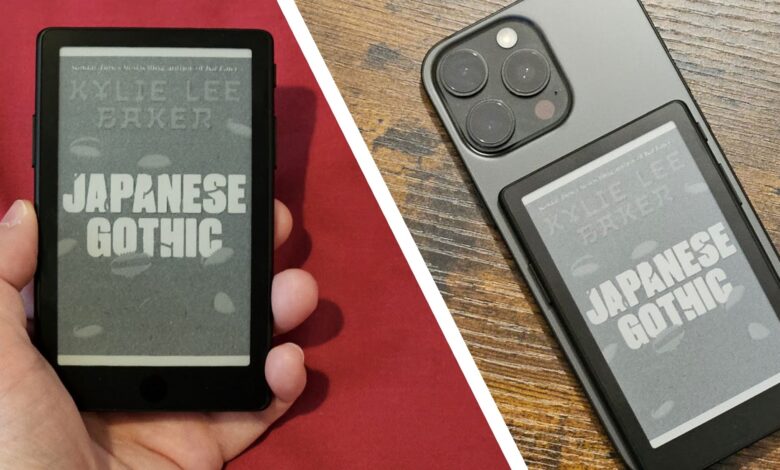
The primary engineering achievement of the Xteink X4 Pro is its ultra-light, ultra-thin footprint. Measuring 111 x 69 x 5.95 mm and weighing just 72 grams, the device is designed to minimize bulk when attached to a smartphone. When mounted magnetically to the back of a large handset, such as an iPhone 16 Pro Max, the 5.95 mm thickness sits relatively flush alongside standard camera housing bumps, making it easy to slide into a pocket without adding significant heft.
Despite its physical appeal, the snap-on form factor creates unique durability and handling challenges:
- Magnetic Grip Security: Built-in magnets allow the reader to attach directly to the back of a phone. However, when used over standard smartphone protective cases, the magnetic hold can weaken, causing the reader to shift or dislodge during heavy button presses or while being pulled from a tight pocket.
- Screen Exposure and Fragility: E-paper displays are historically prone to damage from impacts and torque. Because the X4 Pro sits externally on the back of a phone, it remains exposed to drops and pressure.
- Included Protection Limitations: The device ships with a basic flip cover, but the reduced magnetic retention through phone cases limits the cover’s ability to stay securely fastened in everyday scenarios.
For users who prefer to keep their devices separate, the unit functions as a standalone micro-reader. However, at a display size of 4.3 inches, its primary appeal remains its ability to latch onto a phone rather than operating as a conventional handheld e-reader.
Display Performance, Battery Life, and Charging Trade-Offs
The primary hardware enhancements on the X4 Pro focus on visual usability. The 4.3-inch e-paper display offers crisp text reproduction, while the newly introduced front light allows for reading in dark environments—a critical feature missing from the baseline X4 model. Touch functionality simplifies navigation, eliminating the need to rely solely on physical side buttons to turn pages or adjust settings.
Battery performance is another operational strength. Because the reader operates on a lightweight, dedicated operating system rather than a resource-intensive mobile platform, power consumption remains exceptionally low, yielding long operational life between charges.
To achieve the thin 5.95 mm profile, however, the manufacturer opted against including a standard USB-C port. Instead, the Xteink X4 Pro relies on a proprietary charger. While this design decision preserves the thin profile necessary for phone mounting, it introduces the inconvenience of needing a specialized charging cable alongside standard device chargers.
Software Constraints and Firmware Sideloading
While the hardware offers clever engineering, the stock software experience presents significant hurdles. Out of the box, the Xteink native operating system features a basic, unrefined interface that lacks intuitive navigation and formatting options. Recognizing this limitation, Xteink sells the version on its official website as a “developer edition,” explicitly enabling users to flash alternative third-party firmware onto the hardware.
This open approach has fostered an active enthusiast community, particularly on forums like Reddit, where users share custom software builds. Among the available options, alternative firmwares such as CrossInk have become popular replacements for the stock software. Installing custom firmware yields several practical advantages:
- Enhanced user interface layout and typography options.
- More robust file management and organization systems.
- Expanded methods for transferring electronic books onto the internal storage.
While flashing custom firmware onto the X4 Pro is relatively straightforward, selecting and configuring the right build requires technical comfort. As a result, the device is fundamentally oriented toward tech-savvy users who enjoy tinkering with hardware rather than consumers seeking a pre-configured, out-of-the-box experience.
Ecosystem Isolation and the Content Sideloading Process
The biggest operational constraint of the Xteink X4 Pro stems from its underlying operating system architecture. Unlike larger compact e-readers, such as the ViWoods AiPaper Reader, the X4 Pro does not run Android. Consequently, it cannot natively run popular reading applications like Amazon Kindle or Kobo.
This lack of native application support completely alters how users source and manage reading material. Content cannot be downloaded directly from commercial e-book stores over an app interface. Instead, readers must manually manage their digital libraries using external hardware and software:
- Manual Sideloading: E-books must be purchased or acquired on a computer or secondary device before being transferred manually to the X4 Pro.
- DRM Management: Books protected by standard Digital Rights Management (DRM)—such as files purchased through Amazon’s Kindle ecosystem—cannot be read on the X4 Pro without first decrypting and converting them into open formats like EPUB. Recent security updates across major e-book platforms have made DRM removal increasingly difficult, creating a substantial barrier for users with existing commercial digital libraries.
For readers heavily invested in closed commercial ecosystems, this workflow introduces considerable friction. The device requires users to maintain personal, DRM-free document collections rather than relying on cloud synchronization services standard on mainstream e-readers.
Market Positioning and Value Proposition
Priced at $109 / £84 / AU$159 (and frequently discounted to $99 / £76 / AU$145), the Xteink X4 Pro is positioned as an affordable secondary device rather than a primary e-reader replacement. Its pricing reflects its identity as a specialized gadget tailored to early adopters and mobile reading enthusiasts.
Compared to Android-based compact readers, which offer direct access to Kindle, Kobo, and library apps at a higher price point and larger physical profile, the X4 Pro prioritizes extreme compactness and immediate physical accessibility above software convenience. It transforms idle smartphone downtime into reading time simply by being physically attached to the phone in hand.
Ultimately, the Xteink X4 Pro is a highly specialized piece of hardware. For early adopters, tinkerers, and readers who already maintain an independent, DRM-free digital library, the device offers an innovative way to keep a crisp e-paper screen available at all times. For the broader public accustomed to automated cloud syncing and one-click app store purchases, the technical setup and manual content transfers present a clear operational hurdle that defines the user experience.